



Cart
There are no items in your cart.
There are no items in your cart.
18 Hour CE Course
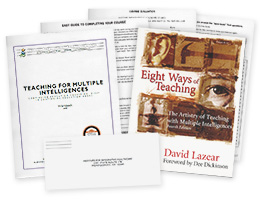
Do you have the Eight Ways of Teaching textbook? See your enrollment options above for "I already own the text".
This course introduces teaching practices for 8 forms of multiple intelligences. These include; verbal, mathematical, visual, kinesthetic, rhythmic, interpersonal, intrapersonal and naturalist. It provides insight into the diversity of learning and includes many clearly-designed examples of multiply-intelligent ways to design learning experiences. The textbook was written for teaching children K-12, but the concepts and strategies are clearly applicable to all forms of communication. NOTE: The textbook for this course is the 2003 edition.
| Teaching for Multiple Intelligences: Background | 1 hour |
| The 8-in-1 Lesson Planning Strategy, as follows: | |
| How to design and structure 8-in-1 lessons | 0.6 hours |
| Making time for 8-in-1 lessons | 1.4 hours |
| The Intelligence-Focused Lesson Planning Strategy | 1.5 hours |
| Teaching for Verbal/Linguistic Intelligence | 1.5 hours |
| Teaching for Logical/Mathematical Intelligence | 1.5 hours |
| Teaching for Visual/Spatial Intelligence | 1.5 hours |
| Teaching for Bodily/Kinesthetic Intelligence | 1.5 hours |
| Teaching for Musical/Rhythmic Intelligence | 1.5 hours |
| Teaching for Interpersonal Intelligence | 1.5 hours |
| Teaching for Intrapersonal Intelligence | 1.5 hours |
| Teaching for Naturalist Intelligence | 1.5 hours |
| Open-book Test and Course Evaluation | 1.5 hours |
I enjoyed this course immensely the questions were thought provoking. I began Planning and re-planning lessons right away and put the ideas to work immediately with my 2 year old and the under 5 yr. olds that attend my day care.Becky Sue Nielson, Stillpoint Therapuetic Massage, Bayfield, WI
This course was not only helpful for the process of teaching massage but for helping my children throughout their school experienceDeborah Nugnes
The book was well written, clear and easy to assimilate.Rebecca Atwell, CMT Lemont, PA
I really enjoyed the course, taugh me to understand many things before I did not realizePatricia Olsen, LMT, NCTMB
Comprehensive, easy to read, and excellently organized. Useful templates included.Vera Ando-Winstead, CMT, NCTMB
This was interesting because I never knew how to combine various exercises to enhance deep learning. I will use what I learned in my massage and wellness classes.Kimberly Huneycutt, LMT
I had less than a month to read the book and complete the course to renew my license. Before I took this course, I have thought how utilizing different intelligences into teaching a subject would encapsulate all the different learning abilities of students. This course only reaffirmed that thought. I will definitely break the methods down and integrate them in teaching, as it will open up a whole new world for me and my students.David Baeza
As a massage teacher, I found the topic most enlightening and have been using it for 2 quarters at my institution. My students have really blossomed since I've been using this strategy.Toni Ann Ridge, LMT, NCTMB
The book, "Eight Ways of Teaching" and the test were the course materials. The author, David Lazear, masterfully translates multiple intelligence research/teaching/planning into understanding and eagerness to dive in. I wish there had been a workbook, but after completing the course, I see the book is the workbook. Thank you for this.Margaret Robinson
A similar course was offered 18 years ago to the teaching staff at the massage school where I taught for 10 years. The information was as interesting, applicable, and valuable to me then as it is now. Not only can this information be used in classroom setting, it is also helpful in determining the learning intelligence of clients to best educate them with regard to self-care. Wonderful course!Nancy Ward
I found the book fascinating.Pamela L. Jordan, LMT
Nicely designed course! Applies to any kind of teaching, not just teaching massage.Jenny Steichen, LMT
Absolutely enjoyed this course! I look forward to putting the information to use in communication as well as teaching.Barbara Bartley Baldwin, LMT
Which of the following statements is TRUE of bodily/kinesthetic intelligence itself, or in relation to this lesson?

Enroll Risk-Free! Examine our courses for up to 90 days and if you're not 100% satisfied by the quality or our service, your full tuition cost will be cheerfully refunded. Learn more about our guarantee.

Take our free online course:
Ethics Refresher
We will not rent/sell your email to anyone. You'll also receive our newsletter and special offers.

Take our free online course: Ethics Refresher
We will not rent/sell your email to anyone.
You'll also receive our newsletter and special offers.
Thank you! An email will be sent to the address provided with instructions on how to enroll in this 1 CE hour course - FREE!
If you do not see our email within a few minutes of signing up, please check your Spam/Junk folders it may have been delivered there instead of your inbox.
If, by chance, you still have not received it within 5 minutes, please call us at 1-800-364-5722, Monday-Friday, 9am-5pm EST for assistance.
 Massage for Edema
 Ethics: NCBTMB Standard V
 Utilizing Massage Therapy Research