



Cart
There are no items in your cart.
There are no items in your cart.
15 Hour CE Course
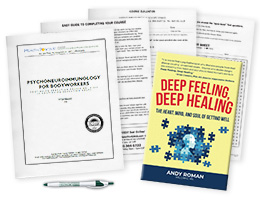
Do you have the Deep Feeling, Deep Healing textbook? See your enrollment options above for "I already own the text".
The science of psychoneuroimmunology (PNI) investigates the mind/body link. This course focuses on PNI in relationship to body memory. The course will help you better understand the emotional component of your work and facilitate longer-lasting positive results. It does not teach hands-on skills.
| Sanity and Healing: | 1.5 Hours |
|
|
| The Biology of Emotional Integration: | 2 Hours |
|
|
| Feelings and the Mind/Body Interface: | 2 Hours |
|
|
| Communication Central: | 1.5 Hours |
|
|
| Psychoneuroimmunology: | 2 Hours |
|
|
| Inner Fragmentation: | 2 Hours |
|
|
| Life Issues: | 1 Hour |
|
|
| Integration with Feeling: | 2 Hours |
|
|
| References | |
| Open-book Test and Course Evaluation | 1 Hour |
PNI is a very interesting subject for anybody dealing with pain, wich likely includes everybody! This course was informative and in-depth.Cory Chase, LMT, Morgantown, WV
Wonderful! So full of insight and useful information.Dana H., RN, LMT Nashville, TN
This is the all time best course I have ever taken. I am very lucky to have found it. Thanks so much for offering itKaren Bauer, Traveleres Rest, South Carolina
I thoroughly enjoyed reading the book. I found it fascinating and felt it held much truth.Laura Young Massage Therapist NCTMB
This is an excellent course, very informative, author proves/supports his assortions well.Linda Wozniak CMT, LMT Vital Signs Massage of Bodywork
I really benefited by this course and have purchased more copies of the book for people I know who would benefit by its contents. Having a chat room about the contents of this course would be a plus!Liz
I liked it a lot. Author is right-on. Extremely interesting, fascinating and important knowledge for body-workersLynessa O'Brien L.M.T. & emotional integration.
A wonderful example of understandable writing that teaches a huge amount of informationNona Fries, NCTMB, CHt
A good read for anyone working in healthcare, and/or bodywork fields, both personally and professionally!Patricia Sirois, RN, LMT, Springfield, NH
This course was so informative, and perfectly timed in my life!! i really needed to learn this stuff right now!paula helfrich russel, nctmb, lmt
This course gave me some concrete reasoning as to why people will release their emotions while I'm breaking up their "pockets of pain" during a bodywork session.Rosemary E. Heermance, NCTMB Pacific Oasis Medi Spa - Lancaster,
I was very interested in the material. It gave me a different way of thinking about pain and healingVivian Beran NCMT
Excellent insight into the mind body connection. The course provided me with awareness on how I can further help/understand my clients as well as myself.W. Scott Pollard CMT Rockville, MD
This was the best course I have ever taken - perhaps it resonates with what I was looking for in my personal healing. Wonderful medical insights - I am a RN, LMT, Reiki Master & HeartMath practitioner - this went much deeper into the power of emotions on physical well-being. Thank you!!Barbara Hudak, LMT, RN,
I really enjoyed reading Deep Feeling, Deep Healing and got a lot out of it that I can use in my practice and even more that I can use in my daily life. Thank you.Miranda Bryant, LMT, NCTMB
This course really makes you think. I must say I enjoyed it. Thank you.Debra Price, LMT, NCTMB, AMTA
I highly enjoyed and recommend this course!Trina Davis, NCTMB
The book for this course was outstanding. The author must be an amazing person. The information was clear, concise, and heartfelt.Nancy Arias, LMT
I was thrilled to study this very relevant subject matter and happy that it was offered. It validated all that I've ever witnessed in my own practice, giving scientific evidence to the understanding that "the body tells the story!" My expectations were, however, that the information would be more biochemical and anatomical in nature as opposed to psychotherapeutical. Regardless, the information was valuable and I would recommend this course to any health practitioner, not just massage therapists.Rebecca Summers, LMT, NCTMB
This was my first self-study course. I loved it! It was very insightful, and brought to the table aspects of my practice I can work on improving.Mica Helms, LMT, NCTMB
LOVE the book!! It was a great read and highly recommended for anyone interested in mind-body therapy.Monica Robbins, LMT, NCTMB, ABMP
The course was very inlighting to me. Mr. Roman has a very good handle on feeling mind and getting well with heart and soul.Wayne Martin, LMT
This book really helped me to understand why people feel the way they do, it gave me a better understanding of how powerful the mind can be and how the body and mind coralte.Jennifer Carey
Great course, loved it!Annette D., LMT
Great course... every medically involved human being needs to read and take this course!Keri Ann Heitzman, LMT, NCTMB
Fantastic course! Great insights into the mind-body system, the cascading of bio-chemical responses, fragmenting of traumas in the tissues, the role of the heart, electrolytes, hormones and neuropeptides play in the overall health of our amazing bodies. The author presents the science behind body-mind health, thoughtful case studies and great suggested books for further reading.Renae Hawkos, RMT, NCTMB
I loved this course! Andy's book is informative and engaging, and was a pleasure to read beginning to end. Thank you!Elisabeth Nehme, NCTMB
Loved the book. Will reread often.Tamara Casto, LMT
Excellent course!! I am thrilled I found this institute. I cannot speak highly enough of the book, deep feeling, deep healing. Way exceeded my expectations. I have already recommended it to others. Thank you for providing excellent material.Hope Epert
This course was exactly what I needed to give me the background and confidence to adequately bring up to clients and people the power of the heart and how our emotions directly reflect our biology. Backed by some really amazing and awe-inspiring scientific studies and case studies! This information is a MUST for every human being to understand! I LOVE this topic and it is going to open many doors for me.Stephanie Bellocchio, LMT
Overall, this class was fascinating, and provided me with a strong framework and a language to describe the bodywork I've already been doing. I was hoping for more direct instructions and bodywork techniques about how to apply the theories of PNI in an actual treatment session. More information about the location of and how to activate the endocrine points, etc. would have been appreciated.Allison Kirk, LMBT
I really enjoyed reading Deep Feeling, Deep Healing and got a lot out of it that I can use in my practice and even more that I can use in my daily life. Thank you.Miranda Bryant, LMT, BCTMB
This course was extremely interesting. If you are a holistic practitioner that is focused on how the mind, body and spirit are connected in healing, this is the course for you! You will understand how suffering, pain, joy and happiness are all interconnected to mental and physical health. Using PNI techniques, a deeper healing can be accomplished with your patients. I definitely recommend this course.Jules Brunson, LMT
This was a great class, building on other knowledge, taking me further, and supporting me in self development and helping others. Thank you!Catherine Burton, LMT, BCTMB
This course is somewhat beyond the scope of my profession as a massage therapist. But there is a lot of valuable insight into the pain process, depression and emotions. At the very least, it teaches me to recognize the symptoms in my clients so I can refer them to an appropriate professional.Susan L. Plouffe, LMT
"The human body structurally demonstrates the fundamental and natural necessity for boundary-setting as a means of sustaining health, especially in two locales: the skin and the immune system. The skin is both our outermost organ and the site of physical contact with the world, marks where the self ends and the "outer" world beings. Also known as the "integument," it functions as the built-in delineator of our separateness and our integrity as individuals. When someone touches us lovingly and appropriately, we feel soothed, stimulated, "in touch", and connected. Gentle touch not only elicits a cascade of mood altering endorphins and the relaxation response to make us feel good, it also triggers the skin to release thymopoeitan, a hormone which bolsters our immune competence by stimulating maturing immune cells. When someone touches us without our permission we feel "invaded" and "violated," and our fight-or-flight response kicks in, along with a gush of stress hormones, aborted digestion, elevated blood pressure, and increased muscle tension. Negative contact with the world is an emergency." (Deep Feeling, Deep Healing by Andy Bernay-Roman LMHC, NCC, MS, RN, LMT, 2001, p. 69)
The necessity for intact boundaries, as vital to the integrity of the entire organism, is best reflected in which two parts of the human anatomy?

Enroll Risk-Free! Examine our courses for up to 90 days and if you're not 100% satisfied by the quality or our service, your full tuition cost will be cheerfully refunded. Learn more about our guarantee.

Take our free online course:
Ethics Refresher
We will not rent/sell your email to anyone. You'll also receive our newsletter and special offers.

Take our free online course: Ethics Refresher
We will not rent/sell your email to anyone.
You'll also receive our newsletter and special offers.
Thank you! An email will be sent to the address provided with instructions on how to enroll in this 1 CE hour course - FREE!
If you do not see our email within a few minutes of signing up, please check your Spam/Junk folders it may have been delivered there instead of your inbox.
If, by chance, you still have not received it within 5 minutes, please call us at 1-800-364-5722, Monday-Friday, 9am-5pm EST for assistance.
 Psychology of the Body
 The Mind/Body Connection
 Ethics: Therapeutic Relationships