



Cart
There are no items in your cart.
There are no items in your cart.
13 Hour CE Course
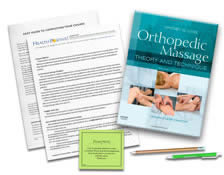
Do you have the Orthopedic Massage Theory and Technique textbook? See your enrollment options above for "I already own the text".
Learn important evidence-based approaches to safe, effective and cost-effective orthopedic massage. The textbook, Orthopedic Massage: Theory and Technique, 2nd ed. (2009), by Whitney W. Lowe, BA, LMT, is the best book available for learning about orthopedic soft tissue disorders. Through text and photographs it explores common soft tissue injuries including cautions, contraindications and the author’s approaches to treatment. This course does not teach hands-on skills. Please seek additional experience, with a mentor, to add hands-on skills.
| Orthopedic Massage and Musculoskeletal Disorders | 0.5 hours |
| Understanding Soft Tissue Injuries | 1 hour |
| Thermal Modalities and Treatment Aids | 1 hour |
| Specific Massage Techniques in Relation to Orthopedic Massage | 1 hour |
| Physiological Effects | 1 hour |
| Foot, Ankle and Lower Leg | 1 hour |
| Knee and Thigh | 1 hour |
| Hip and Pelvis | 1 hour |
| Lumbar and Thoracic Spine | 1 hour |
| Cervical Spine | 1 hour |
| Shoulder | 1 hour |
| Elbow, Forearm, Wrist and Hand | 1 hour |
| General Conditions and Conclusion | 0.5 hours |
| Open-book Test and Course Evaluation | 1 hour |
Excellent Research-Gives credibility to those practicing energy work.Dr. William L. Thomas, ND, MS, Leicester, NC
This course taught in depth clinical information and the book will be a well used reference source.J. Elizabeth Foster, LMP
Excellent course. Very technical and informative. Just what I wanted and needed to learn more. I highly recommend it to all massage therapists.E. Edwards, IV, LMT
This class was a great add-on to previous training that I will be able to add into my everyday practice. I'm glad I chose this class.Patrick Hoffmann, LMT
Comprehensive and invaluable in my practice. I plan to keep this text close at hand to refer to.Craig Milewitz, LMT
I learned several things about muscle that I did not know,both about function and pathologies.James Greer, LMT, NCTMB
Excellent course and will be very helpful in my practice.Susan Story, LMT
I thought this course was EXCELLENT. I do a lot of deep therapeutic massage in my practice and nuch of the information either reinforced, enhanced and enlightened my knowledge of therapeutic massage. I honestly can't think of any additions which would bolster this course. I feel that you all did a great job in presenting the information.Joseph Burchick, LMP
Great course! Learned a lot of techniques and understanding how to treat problems more effectively!Brian Au, LMT
I really enjoyed learning about this subject. Although it overwhelms me initially I realize I have much to learn about this subject and it will be a learning process as I build my knowledge base with these techniques in theory as well as practice. I was also pleased at how much of this I learned in school through other modalities and classes. Thank you for such a great course!Melissa Taylor, LMT
Whitney Lowe is an excellent author and an excellent choice for this course. He Condences a vast amount of information in a short book. It is an excellent quick reference novel for addressing many common orthopedic dis-eases.Geoffrey Allen, LMT
I have been doing massage therapy for 15 years. Last year I wanted a change and went to nursing school. I immediately went to work in an Orthopedic clinic after graduating. This was great, I look forward to sharing this with the Dr. I work for and hopefully intergrate my new career with my old.Jennifer Link, LMT
Loved this course, it was easy to read and understand. There were a few things that i didn't know and it was cleared up for me. Over the last few months I've been thinking of going for my P.T. license and after going thru this course that decision is easy to make.Raymond C. Barrett, LMT
I found this course to be very helpful especially in refreshing some basics and most important it gave me a very clear insight and understanding of the cause of and correct treatment/approach of many injuries. The textbook is very clear covering the material and is very handy to keep around in your practice.Dianthe Oosterhof
I have taken many courses from the Institute and find this course to be, by far, the BEST course ever. Whitney Lowe is exceptional at teaching and covering all aspects of the subject for massage therapists, athletic trainers, physical therapists and doctors. I have even recommended this course to my instructors at Modesto Junior College and CSU Fresno's Athletic Training Program and will be recommending it to my peers. I would most likely seek out other classes from Whitney Lowe because of his ability to be comprehensive and thorough. Fantastic!!!Jillian Hubbel, CMT
Great for the busy practitioner!Emma Chandler, LMBT
The Orthopedic Massage Course will give me invaluable resources to use in my practice within the hospital rehab settingMyrna Jenness, LMT
Excellent course materials and course overall. Exam was to the point and reviewed significant material. I will recommend this course to fellow massage therapists.Heather Thompson, LMT, NCTMb
I truly enjoyed the study book and the information is very useful. I am looking forward to applying these techniques in my practice. Thank-you for putting this knowledge in writing. Also is a great reference book to go back to.Lucie Fontane, LMT
I really found the text very informative.Cynthia Green, LMT, NCTMB
I enjoy taking the on line courses. I am able to read at my own pace, digest the information and then confiendtly take the exam. I have already implemented some knowledge and techniques to my practice that has benefited my clients.Karen Baskin, LMT, NCTMB
You must be doing something right with the courses. I keep coming back for more! Thank you, I'm very satified with the Institute and the many choices of quality course material.L. Hamdi, New Orleans, LA
Very user friendly database/program. I have taken other online courses that pale in comparison RE: organization of material, clarity of test questions, ease of use. That, and it is such a relief to see quality practitioners offering their services with you (I LOVE Whitney Lowe - his work is remarkable), since attending real time work shops is not always an option. Thank you OMERI and Integrative Healthcare!Tara LeGros, LMT, NCTMB
I have taken several courses from the Institute. This text book will be a great resource for many years to come. I will definitely reference the book for specific injuries/ conditions and their treatment. My only wish for this specific course is that it would've come with a dvd.Joy DiGiovannantonio
I really think it is great information that I can easily apply to the massage therapy work that I am already doing.Kimberly S. Freeman, LMT
This was a very interesting read! Thanks for the useful content.Meredith M. Blum, LMT
This is such an great course. I love Whitney Lowe. With this new information and a great deal of practice I will be able to take my practice to a much MUCH higher level of excellence!Alisa Allen, LMT, NCTMB
I loved the course and learned things that I did learn in school. Wonderfully done.Janet Monroe, LMT
Loved this course! It was challenging but well worth the time and effort. The text was wonderful; well written and laid out and covered an enormous amount of information in a clear and concise way. The text will be a great source of reference that I'm sure to use frequently.Dianna LeBeau, LMT
Very informative. Great refresher on anatomy.Leigh MacDonald, LMT
Always great material! Keep it up!Qiana Thompson, LMT
Great course, Great education, Easy to learn!Joshua Gautreau LMT
Very thorough material. I feel this will be resource that I can go back to and utilize with my clients.Jennifer Dutton, LMT
This course exceeded my expectations. The book will be a great resource for reviewing particular orthopedic pathologies and treatment.Lynnette Gutierrez, LMT
I thoroughly enjoyed this material and the illustration of applications were quite helpful to visualize the text. Applying this additional knowledge to aiding with client's pain and conditions will prove to be beneficial in my practice.Chelsea Plag, LMT
I was very pleased with this course. It had updated information with helpful tips through the book as well as good quality pictures. For massage therapists, the contraindications and anatomy/physiology are very educational. The techniques can be immediately used in my massage or Physical Therapy practice.Kathy Aller, LMT
Even though this a field that I have been working in for the past 22yrs, when I got out of Massage School in 1994, they didn't have a certificate in Ortho, but they did have one in Sports. I have worked over the yrs. for many sports companies, doing Sports, and Orthopedic work in Massage, so It was a very nice review for me. They author made work for every question on the test. This material however, is meant to be gone through in a 3 month class to properly retain the material. Its a lot of material even for a review. I look forward in taking his next Ortho certification. Thank youMitzi G. Lawson, LMP
The orthopedic massage course was very interesting. It took me back to study material learned in massage school and helped me remember/recall certain structures I normally don't think about, especially the chapters on the knee and ankle. This course is a very good course for all massage therapists!Monica Polanco, LMT
Wow! This course was very well presented. The textbook is very concise and has a great presentation to address all sections of the body. Any massage school would be crazy not to include this in their instruction for students. LMT's should pick up this course.Lauri A. Hooker, LMT
I've used Whitney Lowe's texts before and he is always an excellent source!!Cynthia L Lee, MPT, LMBT
Text has a lot of important and useful information; definitely enjoyed the course.Michelle McCormick, LMT
I very highly recommend this course. It is very thoughtfully and thoroughly presented with valuable information to treat a large number of the most common complaints that well trained massage therapists can address and obtain positive results that truly help people with movement and pain issues.Gregory Satorie-Robinson, LMT
I absolutely loved this course. In my practice, I work with several physical therapists. The techniques that I leaned in Orthopedic Massage will definitely help the clients that they refer to me.Janet Lindsey, LMT
Course content was extensive and will be very useful in my practice. Content was interesting and I would absolutely recommend this course.Rochelle Davis, LMBT
Great course ... lots of material for further mastery. Thanks!Art Baner, LMP
Wow, my head hurts!! That said, this is an incredible course! One of the best I've ever taken!! Clear content and presentation. I will use this ins my practice and the text will be a valuable resource. This course far exceeded my expectations!!Richard C. Catlett, CMT
Clear,concise,very informative. Enjoyed reading the text and gaining new knowledge.James C. Roldan, LMT, BCTMB
Excellent course! A lot of detail in the information! I will continue to use this textbook as s clinical resource in the future.Carolyn Landers, LMP
"Although the most common symptom is lateral hip pain, it may also radiate into the groin or into the lateral thigh region (Shbeeb & Matteson 1996). Since friction from the iliotibial band is a causative factor, tension in the gluteus maximus and tensor fasciae latae that attach to the iliotibial band may play a role in the onset of the problem as well.
The other gluteal muscles, especially gluteus medius and minimus should not be ignored in this problem either. Tendinopathy in these muscles, especially near their distal attachment sites, may often masquerade as trochanteric bursitis (Kingzett-Taylor et al 1999). However, a detailed physical examination should help clarify the location of the pain." (Orthopedic Massage: Theory and Technique by Whitney W. Lowe, 2003, p. 126)
As a therapist treating a client with trochanteric bursitis, it is important to:

Enroll Risk-Free! Examine our courses for up to 90 days and if you're not 100% satisfied by the quality or our service, your full tuition cost will be cheerfully refunded. Learn more about our guarantee.

Take our free online course:
Ethics Refresher
We will not rent/sell your email to anyone. You'll also receive our newsletter and special offers.

Take our free online course: Ethics Refresher
We will not rent/sell your email to anyone.
You'll also receive our newsletter and special offers.
Thank you! An email will be sent to the address provided with instructions on how to enroll in this 1 CE hour course - FREE!
If you do not see our email within a few minutes of signing up, please check your Spam/Junk folders it may have been delivered there instead of your inbox.
If, by chance, you still have not received it within 5 minutes, please call us at 1-800-364-5722, Monday-Friday, 9am-5pm EST for assistance.
 Ethics: Therapeutic Environment
 Oncology Massage: Fact vs. Myth